
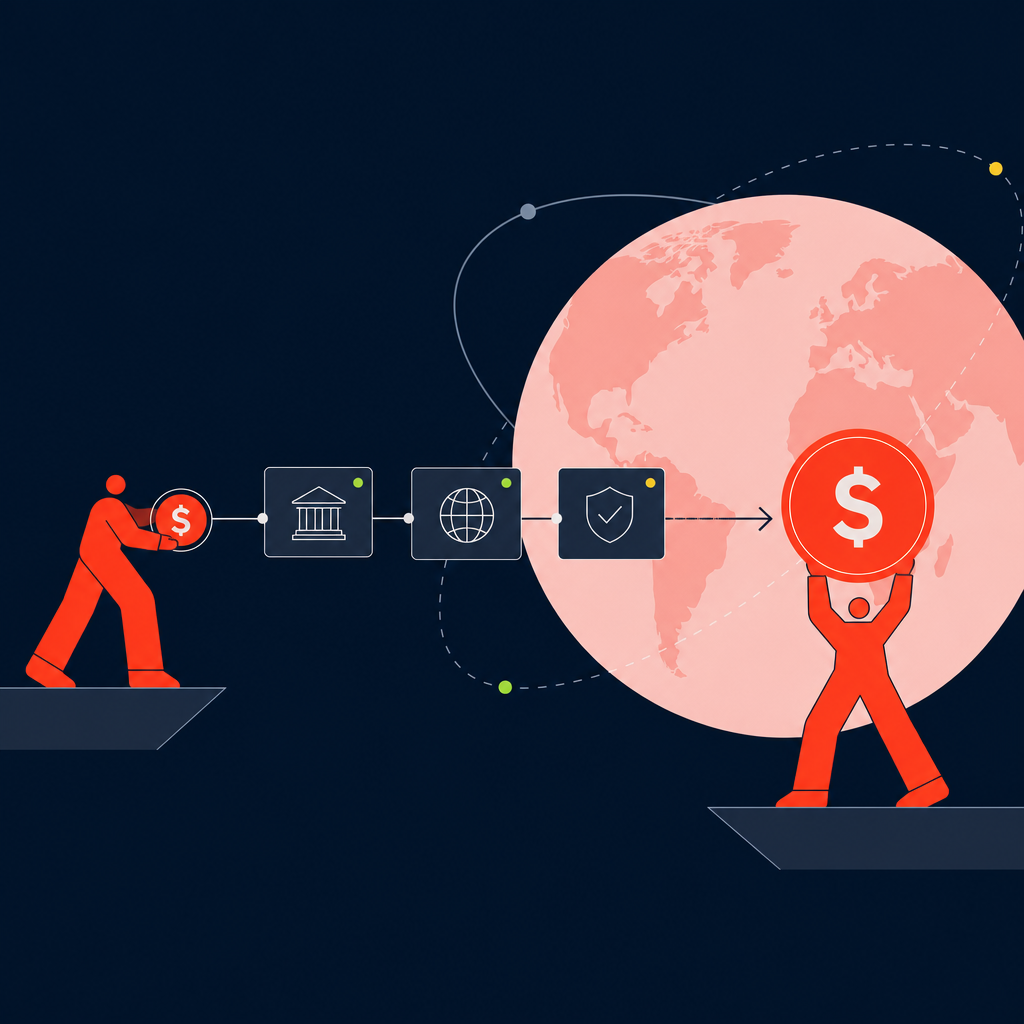
Cross-border payment processing is the complete mechanism of routing, converting, and settling monetary transactions between entities located in different countries and currency zones. When a company operates across borders, every transfer must pass through national clearing systems, foreign exchange (FX) clearing operations, and regulatory checkpoints. Managing this pipeline requires balancing transaction speed against intermediary bank fees, currency volatility, and local compliance rules to maintain financial control and compliance.
What cross-border payment processing actually means for global business
Cross-border payment processing is the structural system that moves funds across geographic borders and sovereign currencies, enabling businesses to fulfill international financial obligations. It connects regional banking rails, currency exchange markets, and compliance frameworks to deliver funds from a payer's bank account in one jurisdiction to a recipient's account in another.
Cross-border payment processing handles financial transactions between parties residing in different countries. Unlike domestic payments, which settle within a single national clearing network like the Automated Clearing House (ACH) network in the United States or Faster Payments in the United Kingdom, international transactions require cross-currency conversion and multi-bank communication.
For growing companies relying on international talent, payment execution dictates how efficiently team members are paid and how accurately finance records transaction costs. A failure anywhere along the payment chain results in delayed worker payments, unexpected fee deductions, and complex accounting reconciliations.
The evolution from legacy bank wires to modern payment flows
Traditional cross-border payment methods historically included cheques, consignment, advance payments, and standard bank transfers. These legacy mechanisms were designed for low-frequency, high-value international trade rather than modern, high-volume operational workflows. Cheques required physical transit and processing delays of several weeks, while consignment and advance payments introduced substantial credit risk for buyers or sellers.
As global commerce expanded, standard international bank wires became the default corporate transfer mechanism. However, traditional bank transfers rely heavily on correspondent banking networks. In these networks, money moves through multiple intermediary institutions before reaching its final destination. Each bank in the sequence charges processing fees and applies its own FX markup, creating unpredictable costs and settlement delays.
Modern cross-border payment architecture replaces these fragmented chains with direct local clearing access and automated routing technology. By integrating directly into local banking networks across multiple jurisdictions, specialized platforms bypass intermediary banks entirely. This modern approach lowers transfer expenses, provides transparent currency rates, and accelerates settlement timelines from days to hours.

Key terms in international payment operations
Key terms in international payment operations define the financial mechanisms, clearing channels, and structural layers required to move funds across sovereign currency boundaries. Mastering concepts like correspondent banking, payment rails, FX spreads, and payment groups allows Finance leaders to audit hidden transfer costs and eliminate operational friction across international payout networks.
Before evaluating infrastructure architecture, Finance teams must establish a common vocabulary for payment rails and currency mechanisms. Understanding these core terms enables finance managers to evaluate payout vendors objectively:
- Correspondent Bank: An intermediary financial institution that provides services on behalf of another bank, helping move international wire transfers between institutions that do not share a direct relationship.
- SWIFT Network: The Society for Worldwide Interbank Financial Telecommunication (SWIFT) network, a global messaging system that financial institutions use to securely transmit instructions for money transfers.
- Payment Rail: The underlying technical platform or network infrastructure that facilitates the movement of money between a payer and a payee, such as ACH, the Single Euro Payments Area (SEPA), or domestic real-time payment networks.
- FX Spread: The difference between the wholesale interbank foreign exchange rate and the retail rate charged to a customer, representing a primary hidden cost in international payments.
- Payment Orchestration: Software technology that intelligently routes payment transactions across multiple payment gateways, acquiring banks, and local rails to optimize speed, cost, and approval rates.
- Payment Group: A strategic grouping of international payouts categorized by payout currency, funding account, or execution date to optimize foreign exchange execution and simplify batch approval processes.
- Land Date: The confirmed date on which transferred funds arrive in the beneficiary's local bank account and become fully available for use.
The structural mechanics of cross-border payment processing
The structural mechanics of cross-border payment processing rely on interconnected clearing houses, correspondent banking chains, and local settlement networks. Money moves across borders either through traditional SWIFT messaging between intermediary banks or through direct local rails governed by payment orchestration systems that optimize currency routing.
Understanding these terms helps clarify how money physically and digitally moves through international rails. Behind every international payment sits a complex web of currency exchanges, banking networks, compliance checks, and payment processors.
+-------------------------------------------------------------------------+
|                        ORIGINATING COMPANY (PAYER)                      |
|                      Funds Deposited in Base Currency                   |
+-------------------------------------------------------------------------+
                                     |
                                     v
+-------------------------------------------------------------------------+
|                      PAYMENT ORCHESTRATION LAYER                        |
|   1. Compliance & KYC Verification  2. Automated Payment Grouping    |
|   3. Dynamic FX Conversion Rate     4. Smart Local Rail Routing         |
+-------------------------------------------------------------------------+
                                     |
                +--------------------+--------------------+
                |                                         |
                v                                         v
+-------------------------------+       +---------------------------------+
|   LEGACY CORRESPONDENT RAIL   |       |       LOCAL PAYMENT RAIL        |
|  - SWIFT Intermediary Bank A  |       |  - Direct In-Country Settlement |
|  - Intermediary Bank B (Fee)  |       |  - SEPA / ACH / Faster Payments |
|  - High FX Spread Added       |       |  - Full Value Delivered         |
+-------------------------------+       +---------------------------------+
                |                                         |
                v                                         v
+-------------------------------------------------------------------------+
|                       RECIPIENT BANK (BENEFICIARY)                       |
|                       Funds Settled in Local Currency                   |
+-------------------------------------------------------------------------+
When an enterprise executes a global payout, the transfer follows one of two primary pathways: traditional SWIFT messaging or local rail orchestration. In a SWIFT workflow, the payer’s bank sends a cryptographic message to the payee’s bank instructing it to credit the recipient’s account. If no direct relationship exists between the two institutions, the message routes through one or more correspondent banks holding bilateral accounts, known as Nostro and Vostro accounts.
Intermediary banking networks and correspondent friction
The correspondent banking model introduces significant friction into global finance operations. Because each intermediary bank acts independently, no single institution owns the full lifecycle of the transaction. This decentralization creates three specific operational challenges:
- Deducted Lift Fees: Intermediary banks routinely subtract handling fees directly from the principal transfer amount without prior notification to the sender.
- Unpredictable Settlement Times: Transfers can sit in manual compliance queues at any intermediate bank, delaying worker settlement by up to five business days.
- Reconciliation Gaps: When funds arrive short of the invoice amount due to intermediary fee deductions, accounting teams must manually investigate and issue adjustment payments.
This friction is particularly severe when paying non-employee workers across multiple regions. Managing individual wire transfers through legacy portals creates recurring administrative overhead for finance departments.
Payment orchestration and smart routing across payment rails
To overcome correspondent banking friction, advanced treasury teams rely on payment orchestration engines. Orchestration software acts as an intelligent control layer above disparate banking APIs, regional card networks, and local clearing facilities.
Instead of sending an international wire from a central bank account in London or New York, an orchestrated workflow converts currency at wholesale rates and injects funds directly into local clearing systems like SEPA in Europe, ACH in the United States, or the Central Bank of Brazil's PIX network. Managing complex cross-border transactions through unified payment orchestration platforms allows organizations to handle currency exchanges, banking connections, compliance checks, and payout processors within a single framework.
Smart routing algorithms automatically select the fastest and cheapest payment rail based on the beneficiary country, currency, transfer value, and local banking hours. This setup drastically reduces wire fees while ensuring that recipients receive the exact invoiced amount on the intended land date. Finance managers seeking detailed execution steps can explore setting up cross-border payments for contractors to align domestic enterprise resource planning (ERP) systems with international payout rails.
Why recurring contractor payout cycles break legacy banking models
Recurring contractor payout cycles break legacy banking models because traditional wire transfers were built for low-volume, high-value B2B transactions rather than frequent, multi-currency payouts. High FX spreads, unpredictable lift fees, manual invoice reconciliation, and recurring KYC verification cause severe administrative burden and delayed settlement for international workers.
These traditional mechanisms work well for occasional corporate invoices, but they collapse when applied to high-volume contractor payouts. Companies relying on distributed teams often attempt to process monthly payments using standard corporate online banking portals, creating systemic operational bottlenecks as contractor headcount expands.
| Operational Challenge | Legacy Banking Portals | Modern Payment Orchestration |
|---|---|---|
| FX Rate Execution | Retail spread (2.5% - 4.0% markup) | Wholesale interbank rate locked upfront |
| Fee Transparency | Unpredictable correspondent bank deductions | Guaranteed full net amount delivered |
| Data Collection | Manual copy-pasting of SWIFT/IBAN codes | Self-serve worker onboarding & account verification |
| Reconciliation | Manual ledger matching per wire | Automated ledger syncing via ERP integration |
| Settlement Speed | 3 to 5 business days | Same-day or next-day local rail settlement |
The hidden drag of foreign exchange spreads and correspondent fees
The most significant financial loss in legacy cross-border payment processing occurs through non-transparent foreign exchange markups. Commercial banks rarely offer businesses the true interbank exchange rate. Instead, they apply a retail markup ranging from 2% to 4% above the mid-market rate, quietly inflating the total cost of global payouts.
In addition to FX markups, traditional wires suffer from unpredictable correspondent bank fees. A company sending $2,000 to a software engineer in Argentina or Poland may discover that only $1,940 arrives in the beneficiary’s bank account. Intermediary banks along the SWIFT route absorb the missing $60.
Cost Breakdown of a Legacy $2,000 International Wire:
----------------------------------------------------
Base Payment Amount:             $2,000.00
Originating Bank Wire Fee:        +$  35.00
Retail FX Markup (3.0% Spread):   +$  60.00
Intermediary Lift Fees:           +$  25.00  (Deducted from beneficiary payout)
----------------------------------------------------
Total Cost to Business:          $2,095.00
Actual Amount Received by Worker: $1,940.00
This shortfall creates immediate friction between businesses and their international contractors. Contractors demand full reimbursement for missing funds, forcing finance teams to process secondary wire transfers that incur additional transaction fees. Over an operational year, these cumulative fee leakage points erode financial margins significantly.
Manual verification, compliance checks, and payout delays
Beyond direct transaction expenses, managing multi-country contractor payouts manually generates immense operational friction. Finance teams must collect, verify, and update bank account details across dozens of currencies and national formatting standards. A single mistyped International Bank Account Number (IBAN) or missing routing code causes bank rejections, which often take days to clear while funds remain locked in banking suspense accounts.
Compliance oversight adds another heavy layer of manual effort. Before executing international transfers, finance departments must verify that recipients comply with local Know Your Customer (KYC) guidelines and anti-money laundering regulations. They must also screen payees against global sanction lists, including those managed by the US Treasury's Office of Foreign Assets Control (OFAC).
When finance teams run these compliance checks manually in individual banking portals, administrative efficiency plummets. Payment files require manual upload and approval across separate banking tools, increasing human error risks and delaying worker payments. Organizations struggling with manual international payouts can learn how automating business international payments reduces processing times while standardizing compliance routines.
How Finance leaders build scalable cross-border payout operations
Finance leaders build scalable cross-border payout operations by grouping multi-currency transfers, centralizing payment funding, and executing through local payment rails. By adopting unified orchestration platforms, finance teams eliminate repetitive manual approvals, gain full payout visibility, and secure predictable FX execution across their global workforce in 180+ supported countries for workforce coverage.
To eliminate these friction points, Finance must move from piecemeal banking portals to a unified cross-border payment framework. Building a scalable payout architecture requires structuring payment groups, locking in transparent foreign exchange pricing, and automating bank reconciliation directly within core financial systems.
Consolidating payment groups for multi-currency execution
Scalable operations begin by organizing payouts into structured payment groups based on currency, region, or funding requirements. Rather than processing hundreds of individual contractor invoices piecemeal, finance teams execute batch payments aligned with fixed funding schedules.
By aggregating payouts into consolidated currency pools, organizations achieve three treasury advantages:
- Volume FX Rates: Converting currency in large batch blocks enables finance teams to negotiate lower wholesale FX margins than individual wire transfers allow.
- Streamlined Approval Workflows: Single-batch authorization replaces repetitive manual sign-offs for hundreds of separate invoice payments.
- Synchronized Funding: Companies can fund a central payment account in their primary operational currency (such as USD, EUR, or GBP) and allow the platform to distribute exact local currencies across target countries automatically.
This consolidated approach ensures that international contractors are paid accurately in their local currency on their guaranteed land date without exposing treasury teams to currency fluctuations.
Establishing complete payment status visibility and automated reconciliation
Complete financial control requires real-time visibility into the exact status of every outgoing transfer. Legacy bank wires provide minimal tracking, leaving finance teams unable to confirm whether funds are in transit, held in compliance verification, or settled.
Modern payment infrastructures provide complete transaction monitoring from execution to settlement. Automated status tracking notifies finance managers instantly if a transfer encounters an account error, preventing missing payment surprises. Furthermore, direct API integration between payment orchestration tools and ERP platforms enables automatic ledger reconciliation. When payments clear, accounting ledgers update automatically without manual data entry.
Growing enterprises often refine their payout structures alongside broader global workforce strategies. For instance, Datadog moved roughly 15 EOR-based international teams to Papaya and later transitioned two EOR countries to its own entities with support. Enterprise platforms that combine workforce management with payment execution allow finance leaders to manage both contractor networks and local payroll units within a single framework. Finance teams can discover how the platform coordinates global payment architecture to unify workforce compliance and automated multi-currency transfers.

Taking control of your international payment infrastructure
Modernizing cross-border payment processing requires evaluating your technology stack against clear operational standards, transforming an administrative cost center into a disciplined strategic capability. By shifting away from fragmented bank portals toward consolidated orchestration, finance leaders eliminate surprise fees, ensure audit readiness, and maintain total financial control over global cash flows.
Transitioning away from legacy banking portals allows Finance departments to establish complete control over international cash flows. To modernize your payout operations, focus on these clear immediate priorities:
- Audit Total FX and Transfer Costs: Measure the true cost of global payouts by calculating retail FX spreads, bank wire fees, and correspondent bank lift deductions across all international accounts.
- Eliminate Manual Bank File Management: Replace manual CSV banking uploads with secure, automated API integrations connecting your ERP directly to local payment rails.
- Standardize Worker Onboarding and Verification: Implement self-serve contractor portals that verify bank details and conduct KYC compliance checks automatically before initial payouts.
- Enforce Guaranteed Worker Land Dates: Transit to local payment clearing systems (SEPA, ACH, domestic real-time rails) to ensure workers receive exact invoiced amounts on schedule.
By establishing an orchestrated, multi-currency payment infrastructure, global businesses protect their operating margins, minimize administrative workload, and deliver a superior payment experience to international workforce partners.
Frequently asked questions
How can a business improve cross-border payment processing for contractors?
A business can improve cross-border payment processing by moving away from traditional wire transfers and adopting payment orchestration systems that use local payment rails. Local rails eliminate correspondent banking lift fees and deliver full invoice values directly to contractor accounts. Additionally, implementing self-serve onboarding portals automates KYC compliance verification and bank account validation, eliminating bank rejections and manual payment delays.
How can a company automate recurring contractor payments across multiple countries?
A company can automate recurring contractor payments by integrating its invoice management or ERP software with a dedicated cross-border payment platform using secure APIs. This configuration allows finance teams to aggregate invoices into consolidated payment groups, lock in batch FX rates, and execute multi-currency payouts automatically based on predefined approval schedules.
How should Finance evaluate payment companies for a distributed workforce?
Finance teams should evaluate international payment companies based on total cost transparency, currency coverage, local payment rail access, and compliance automation. Key criteria include whether the provider offers wholesale interbank FX rates without hidden spreads, guarantees zero correspondent bank fee deductions, automates worker KYC screening, and integrates directly with existing enterprise ERP and accounting platforms.
How can a business control FX costs and hidden fees on international payouts?
A business can control FX costs by executing transactions through bulk payment groups rather than processing isolated wire transfers. Bulk transfers allow organizations to secure wholesale interbank foreign exchange rates. Routing payments through local clearing networks also avoids intermediary correspondent banks entirely, preventing unexpected fee deductions along the transit chain.
The next step is cross-border payment operations in your own setup
Bring your countries, worker mix and payment cycles to a Papaya specialist and get a straight answer on what changes.