
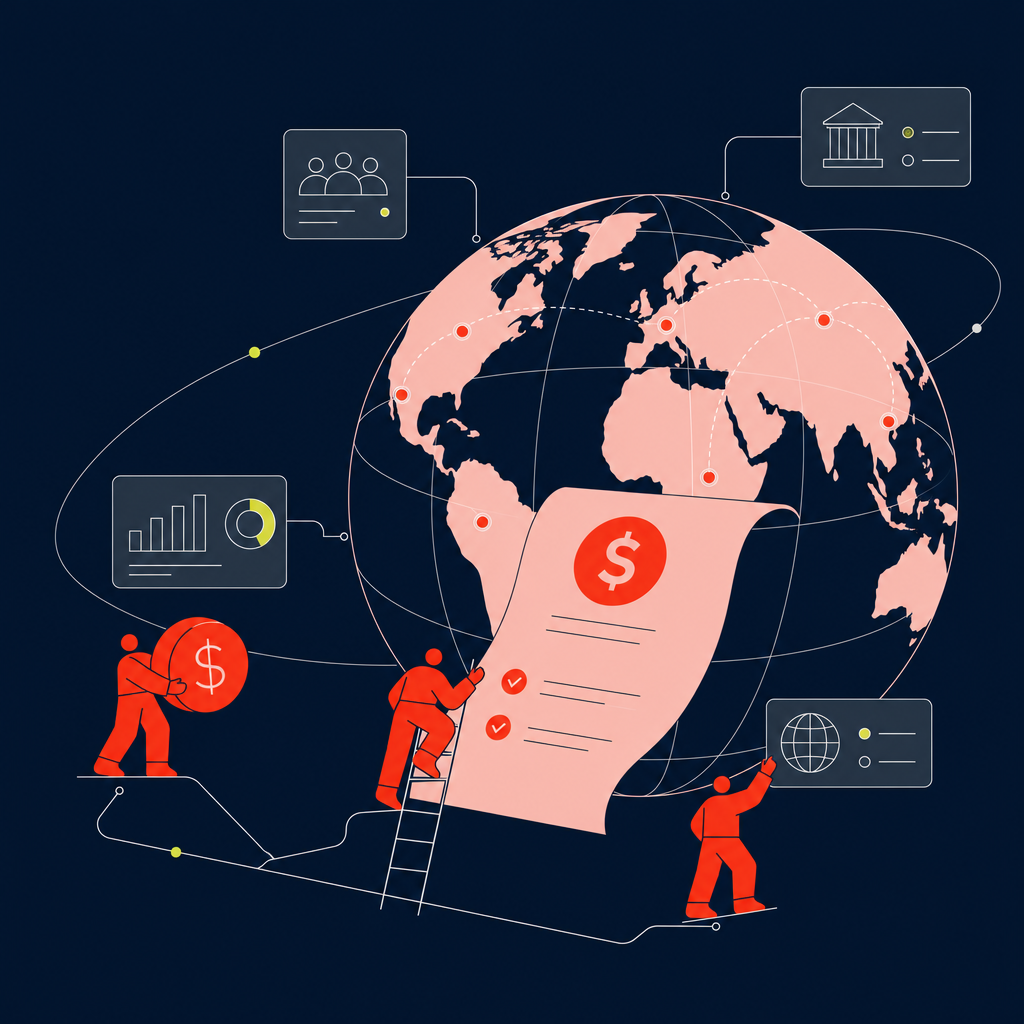
What Is a Global Payroll Provider?
A global payroll provider is a platform or service that helps a company pay workers across multiple countries while managing local payroll rules, statutory obligations, payment timing, reporting, and payroll data in one operating model. The global payroll solution that gets you to 200 employees is not always the one that gets you to 2,000, and that gap is where payroll starts to break.
At enterprise scale, global payroll is much more than gross-to-net calculation in several currencies. It becomes a control system for compliance, workforce visibility, audit readiness, liability management, and financial control. Payroll teams need accurate employee data, country-specific rules, timely approvals, clear exception handling, and reliable payment execution in every market where the business operates.
That operational pressure is why global payroll providers differ so sharply. Some mainly coordinate across local vendors. Some own more of the operating infrastructure themselves, including licensed delivery capabilities in key markets. Others combine payroll, payments, workforce data, and compliance workflows into a unified model. The difference matters because every handoff adds risk: a file export, a delayed approval, a missing field, an unclear statutory change, or a payment that does not reach the worker on the expected land date.
For a Head of Global Payroll, VP Finance, or Payroll Manager, the first test is not whether a provider can run payroll in many countries. The harder test is whether that provider can maintain compliant, accurate, auditable payroll operations as the company grows, reorganizes, acquires teams, opens entities, works with contractors, and reports to finance leadership across borders.
A true enterprise provider should help payroll move from reactive processing to controlled operations. That means fewer country-by-country workarounds, clearer ownership, standardized data, integration with the systems that already run the business, and a payment layer that treats payroll as a financial obligation rather than a back-office file transfer. Global payroll providers become valuable when they reduce operational drag without asking the company to give up control.

Foundations: The Three Models of Global Payroll
Once the enterprise requirement is clear, the next step is understanding how providers actually operate. Most global payroll providers fall into three broad models: aggregator, in-house, and hybrid or unified. Each can support international payroll, but they differ in ownership, data consistency, accountability, and how well they absorb enterprise complexity.
The aggregator model
An aggregator model coordinates payroll across many local in-country partners. The provider may give the company one commercial relationship, one interface, and a consolidated support layer, while the actual payroll calculations and statutory handling happen through local vendors in each country.
This model can work when a company is expanding quickly and needs coverage in markets where it does not yet have deep payroll operations. It can also reduce the burden of sourcing separate local payroll firms one country at a time. For early international expansion, that simplicity can be attractive.
The tradeoff is control. Because the provider depends on local partners, the company may still face variation in data formats, cut-off dates, service quality, reporting depth, and issue resolution. If something goes wrong, accountability can blur. The global provider may own the relationship, while a local partner owns the correction, recalculation, or statutory filing.
Common signs of aggregator strain include:
- Payroll teams reconciling multiple country outputs manually
- Finance receiving inconsistent reports from different markets
- HR data requiring repeated reformatting before payroll can run
- Country exceptions being handled in email rather than in a controlled workflow
- Root-cause analysis taking too long because ownership is split
The aggregator model is not automatically weak. It has a role. For enterprise teams, though, its limits show up when payroll becomes part of financial governance rather than a country-by-country administrative task.
The in-house model
An in-house model means the provider owns more of the payroll infrastructure, process, and country capability directly. Instead of routing work through a broad patchwork of third parties, it operates more of the process through its own systems, teams, licenses, or controlled delivery network.
The advantage is consistency. The company can often expect clearer process standards, more predictable reporting, and better issue ownership. When the same operating model applies across countries, payroll leaders can compare performance, spot exceptions, and explain outcomes to finance with more confidence.
The challenge is coverage and depth. No provider can make every country identical because statutory rules, banking rails, tax structures, social contributions, and worker classifications vary by jurisdiction. A strong in-house model still needs local expertise, but it should present that expertise through a governed operating layer rather than forcing the client to manage every local distinction alone.
The hybrid or unified model
A hybrid or unified model combines broad country coverage with a standardized data layer, integrated workflows, and a payments infrastructure designed to support payroll at scale. This is the model many enterprise teams are trying to reach when they say they need a single global payroll provider.
The best version of this model does not pretend every country is the same. It separates what should be standardized from what must remain local. Employee identifiers, approval flows, payroll calendars, reporting structures, cost centers, and audit trails can be standardized. Tax rules, statutory filings, country-specific deductions, and local payment requirements must remain compliant with the rules of each jurisdiction.
That distinction is central. Enterprise payroll breaks when teams either standardize too aggressively and ignore local rules, or localize so heavily that global control disappears. A unified provider should help you hold both requirements at once:
- Local compliance where the worker is paid
- Global visibility for the business that funds and governs payroll
- Consistent data movement between HR, finance, and payment systems
- Clear ownership when exceptions, late changes, or failed payments occur
This is why the phrase “global payroll providers” can be too broad for enterprise buying. Two vendors may both claim international coverage, but one may be coordinating disconnected local processes while another is operating a controlled payroll and payments model across countries. For an enterprise buyer, that difference is not cosmetic. It affects liability, audit readiness, employee trust, and the payroll team’s ability to own the process.
Key Terms in Global Payroll and Payments
Once the provider models are clear, terminology becomes the next control point. Global payroll has its own vocabulary, and vague language often hides operational risk. These terms will help you compare providers, challenge assumptions, and understand where responsibility sits across payroll, compliance, and payments.
Gross-to-net
Gross-to-net is the calculation that turns a worker’s gross earnings into net pay after taxes, social contributions, deductions, benefits, reimbursements, and other required adjustments. It is the core payroll calculation, but it is only one part of global payroll operations.
Statutory compliance
Statutory compliance means meeting the legal payroll obligations of a specific country or jurisdiction. This can include tax withholding, employer contributions, payslip rules, filings, employment-related reporting, and required payment timelines.
Employer of record
An employer of record is a structure where a third party legally employs workers on behalf of a company in a country where the company may not have its own local entity. It can support expansion, but it must be managed carefully because employment law, worker experience, and liability still matter.
Local entity
A local entity is the company’s legal presence in a country. Running payroll through an entity usually gives the company direct employment control, but it also creates local obligations around registration, tax, social contributions, reporting, and labor compliance.
Contractor management
Contractor management covers the process of paying and administering independent contractors. It is related to payroll, but not identical. Contractor classification, invoicing, payment terms, tax documentation, and local rules must be handled separately from employee payroll.
Payment rail
A payment rail is the network or method used to move money from the company or provider to workers, authorities, or other payees. Payroll payment rails matter because calculation accuracy is not enough if funds do not arrive correctly and on time.
Payroll calendar
A payroll calendar sets cut-off dates, approval dates, processing windows, funding deadlines, pay dates, and statutory filing dates. In global payroll, calendar control is essential because countries may follow different pay cycles and public holidays.
Land date
The land date is the date funds are expected to reach the worker or payee. Enterprise payroll teams track land dates closely because late pay can damage trust, create compliance exposure, and trigger urgent manual work.
Audit trail
An audit trail is the documented record of payroll inputs, approvals, changes, calculations, payments, and exceptions. It supports audit readiness by showing who changed what, when it changed, and why.
Global payments OS
A global payments OS is an operating layer that connects payroll data, compliance workflows, approvals, funding, and worker payments across countries. The point is not only to process payroll, but to own the movement from approved payroll to compliant payment.
How Top Providers Solve for Enterprise Complexity
Provider evaluation hinges on execution under pressure. Strong global payroll providers tackle three interconnected challenges: fragmented data, multi-country compliance, and the gap between payroll calculation and payment execution. A weakness in any area imperils the entire operating model.
Unifying Data with ERP & HCM Integrations
Enterprise payroll relies on timely, high-quality upstream data. When worker records, compensation changes, cost centers, bank details, terminations, bonuses, and leave data reside in disconnected systems, payroll becomes a reconciliation effort, not a controlled process.
Providers built for enterprise complexity must integrate with HR and finance’s existing systems. This means deep integrations with HCM and ERP platforms, consistent field mapping, controlled data validation, and clear exception workflows prior to payroll approval. Integration is more than a technical feature; it protects the business from late corrections, duplicate entries, and reporting gaps.
The practical goal is a standardized data layer that facilitates answers to common finance and leadership questions:
- What is our total payroll cost by country, entity, department, and worker type?
- Which payroll inputs changed after the cut-off date?
- Which approvals are pending, and who owns them?
- Which exceptions are recurring across countries?
- Which payments have been funded, released, and confirmed?
Without such a layer, payroll teams often act as human bridges between HR, finance, local providers, banks, and employees. They chase spreadsheets, compare exports, and explain mismatches post-facto. This consumes time better spent on improving controls and reducing liability.
This challenge intensifies in complex European markets, multi-entity structures, and organizations grown through acquisition. Each new country or acquisition may introduce a different chart of accounts, pay element naming convention, benefit structure, approval culture, and local provider. A mature global payroll provider should normalize these differences while maintaining essential local compliance details.
Provider evaluation must therefore look beyond demo screens. A polished dashboard doesn’t guarantee clean data movement. Buyers should ask how the provider handles rejected fields, retroactive changes, worker transfers, split cost allocations, off-cycle payments, and country-specific pay elements – critical situations where enterprise payroll either functions effectively or requires manual intervention.
Ensuring Multi-Country Statutory Compliance
Compliance is where global payroll providers demonstrate operational discipline. Payroll is locally governed, even when managed globally. Each country has distinct rules for tax withholding, employer contributions, reporting, employee documentation, payslip content, payment timing, benefits, and termination obligations.
A strong provider integrates compliance into the workflow from the start, not as an afterthought. Compliance should shape data collection, pay element configuration, approval requirements, filing preparation, and change recording for audit readiness.
For enterprise teams, the challenge isn’t just knowing the rules, but consistently applying them at scale. This requires governance across three layers:
- Country rule management: The provider must track local payroll requirements and reflect them in the payroll process.
- Client data control: The company must provide accurate worker, compensation, entity, and cost data on time.
- Exception ownership: Both parties must understand who is responsible for corrections, approvals, filings, funding, and employee communication.
The strongest operating models explicitly define these responsibilities, avoiding reliance on informal escalation chains. They specify actions for late starters, post-cutoff bonus approvals, failed bank validations, or statutory report corrections.
Compliance also impacts worker trust. Employees may not see the full payroll process, but they notice incorrect pay, missing payslips, late deposits, unexplained deductions, and repeated corrections. At enterprise scale, these become talent experience issues that can quickly escalate to finance leadership.
The right provider helps payroll leaders speak the language of control. Instead of reporting "payroll was processed," teams should demonstrate data validation, captured approvals, met statutory obligations, funded payments, and resolved exceptions. This shift is crucial, as payroll affects every employee and carries direct financial and compliance exposure.
Moving Beyond Processing: The Global Payments OS
Payroll processing and worker payments are connected, but distinct. A provider may calculate payroll correctly yet leave the company managing funding, bank files, payment failures, local disbursements, and confirmation across multiple countries. This gap is a primary reason enterprise payroll teams outgrow basic international tools.
A global payments OS treats payroll as a comprehensive financial workflow. It links approved payroll outputs to funding, currency movement, payment execution, tracking, and confirmation. Its value lies in accountability as much as speed. The company needs to know if money moved, where, if it reached the worker, and who owns any issues.
This distinction is most critical when payroll involves employees, employer obligations, authorities, and contractors. Payment timing and banking requirements can vary by country and worker type. Some payments need local rails, while others involve cross-border movement. If the payroll provider’s role ends at calculation, the company retains ownership of the most challenging operational moments.
Papaya Global describes its platform as a global workforce payments platform for payroll, employer of record, and contractor management across 180+ countries. For enterprises, this is vital because payroll operations often need one controlled way to manage diverse worker populations while maintaining compliant execution and financial control.
The most mature approach integrates payroll, payments, and workforce data into a single, governed operating model. The platform should answer:
- Who approved the amount?
- Which entity is funding it?
- Which currency and payment route apply?
- What is the expected land date?
- Has the payment been confirmed?
- What exception, if any, needs ownership?
Integrations also contribute to financial control. Papaya Global supports enterprise needs through deep official integrations with Workday, SAP, and NetSuite. Its features focus on connecting global payroll and workforce payments, rather than treating payment as an afterthought. For a payroll leader, this distinction means fewer manual handoffs and clearer ownership from calculation through payment.
A global payments OS should also support various hiring and payment structures without forcing the company into separate operational silos. Employees, employer of record workers, and contractors may require different treatment, but leadership still needs a unified view of cost, timing, compliance posture, and payment status.
If your workforce includes independent contractors, a related guide on how to pay contractors can help distinguish contractor payment mechanics from employee payroll obligations.
The broader point is simple: enterprise payroll isn’t complete when a calculation file is produced. It's finished when the right worker, authority, or payee receives the correct amount via the proper route, on the correct land date, with a record the business can defend.
Next Steps: Evaluating Your Current Payroll Solution
After the provider models are clear, the practical question is where your current setup is already failing. Start by auditing the points where payroll creates manual work, unclear ownership, compliance exposure, or weak reporting. The goal is not to replace a system because it is old. The goal is to test whether it still supports enterprise control.
A useful evaluation begins with the symptoms your team already feels. Payroll leaders often know where the system is failing before the business does: the same countries create late exceptions, the same reports need manual repair, the same integrations break, or the same employees ask why their pay changed. Those signals are operational evidence.
Use a structured review rather than a vague vendor comparison. Your audit should cover at least five areas:
- Coverage: Which countries, entities, and worker types does the current model support without workarounds?
- Data: Where does payroll data originate, how is it validated, and where does it get reformatted manually?
- Compliance: Who owns statutory updates, filings, country rules, and exception correction?
- Payments: Who owns funding, disbursement, payment confirmation, failed payments, and land date tracking?
- Reporting: Can finance see payroll cost, changes, approvals, and liabilities in a consistent format across markets?
Then look at escalation history. A payroll model that depends on heroic effort will often appear stable until a key person leaves, a new country launches, a merger adds complexity, or finance asks for more detailed controls. If one payroll manager is holding the system together through spreadsheets and memory, the risk is already present.
The next step is to define what “enterprise-ready” means for your company. For some organizations, the priority is replacing disconnected country vendors. For others, it is strengthening payments, improving integrations, supporting contractors and employees together, or creating cleaner audit trails. The right provider profile depends on the failure pattern you are trying to fix.
Papaya Global’s how it works resource is a useful next step if you want to understand how a global workforce payments platform can connect payroll, payments, and workforce operations across countries. Use it as a reference point while you map your current gaps against the operating model you actually need.
The closing lesson is the same as the opening tension: the tool that supports early international hiring may not support enterprise payroll accountability. Global payroll providers are not interchangeable because enterprise payroll is not just a country coverage problem. It is a control problem, a compliance problem, a payments problem, and a trust problem. The provider you choose should help your team own all four.
Frequently asked questions
What is the main benefit of using a single global payroll provider?
The main benefit is control. A single global payroll provider can reduce scattered country processes, inconsistent reporting, and unclear ownership across payroll, compliance, and payments. For enterprise teams, that usually means better workforce visibility, stronger audit readiness, fewer manual reconciliations, and clearer accountability when exceptions occur.
How do I start the process of switching to a global payroll provider?
Start by mapping your current payroll countries, entities, worker types, providers, systems, calendars, data flows, and pain points. Then identify where manual work, compliance risk, and payment uncertainty appear most often. That audit will help you compare providers against real operational needs rather than a generic feature list.
How is the cost of a global payroll provider typically structured?
Cost is commonly shaped by country coverage, worker volume, services included, integrations, payment needs, support model, and whether the provider is handling employees, employer of record workers, contractors, or a mix. The key is to compare total operating cost, including internal reconciliation time and risk, not only the subscription or per-worker fee.
Is a global payroll provider worth it for my company's current size?
It is worth considering when your payroll complexity has outgrown your internal controls. Size matters, but complexity matters more. A company with multiple countries, entities, worker types, compliance obligations, and finance reporting requirements may need a global provider before it reaches a very large headcount.
What are the most common mistakes to avoid when choosing a provider?
The most common mistakes are choosing based only on country count, ignoring payment execution, underestimating integration work, failing to define compliance ownership, and accepting inconsistent reporting as normal. Enterprise buyers should test how the provider handles exceptions, late changes, failed payments, statutory updates, and audit trails before making a decision.
The next step is picking a global payroll provider in your own setup
Bring your countries, worker mix and payment cycles to a Papaya specialist and get a straight answer on what changes.